Burning Down the House
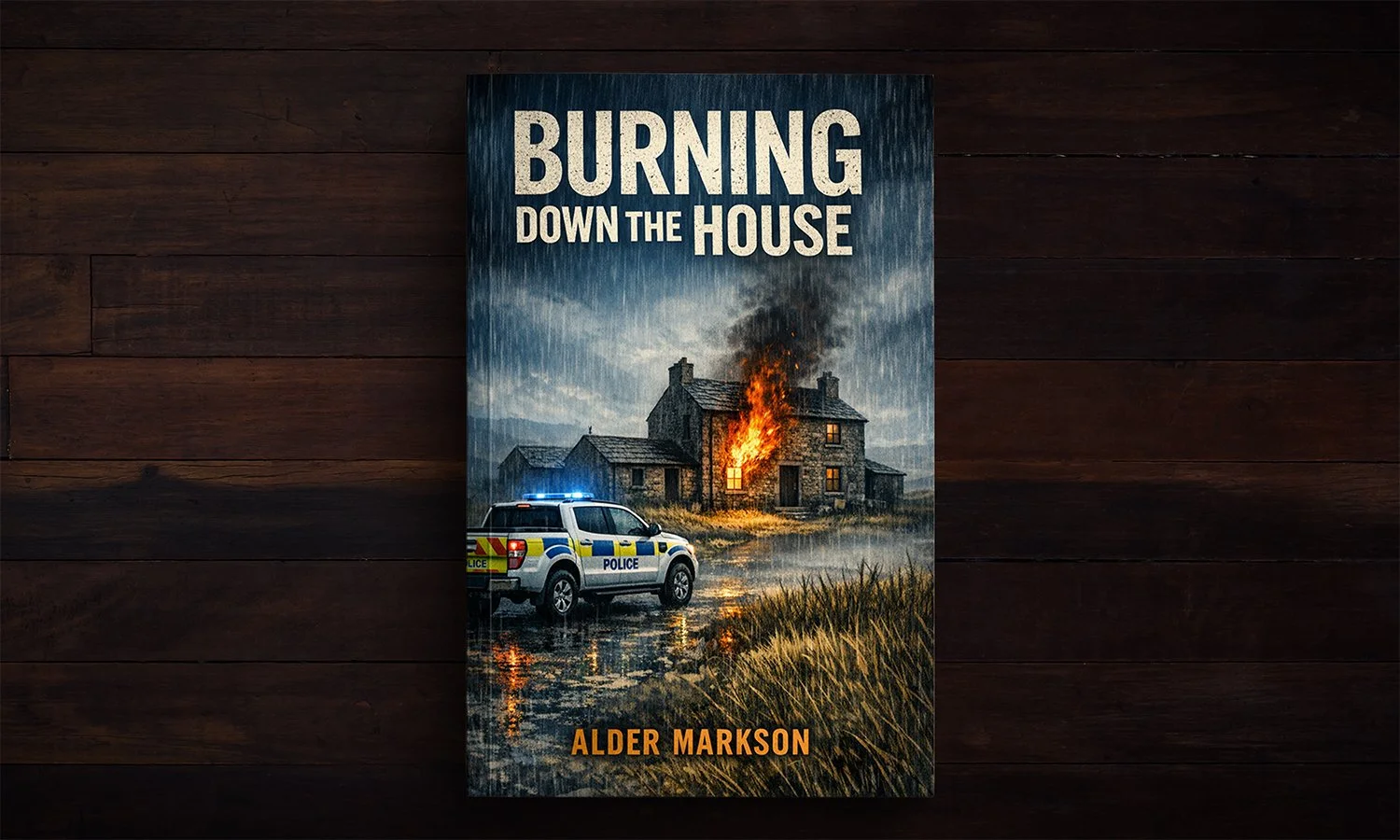
When the land was barren, could it have sensed what the future would bring? When the first people followed the herds into the valleys, did they pause to appreciate the world before them? The first settlers realized that life in the vales would be challenging. Yet, the sanctuary of their isolation balanced these hardships. What was their faith?
As time moved on, the Bronze Age quietly slipped into the Iron Age, leaving little trace on the landscape. It was as if changing the land would offend the ancient gods. The earth endured in its own glory, unchanged by human hands. Then came the Romans, who drove the farmers into servitude, swapping out many of the old gods for their own. Yet, when the Romans eventually vanished, their presence lingered only in isolated pockets. The farmers, unwilling to embrace further change, sometimes returned to their previous ways.
As centuries passed, new powers arrived and departed, each leaving their mark. Men of power came, men of influence departed, but they left only fleeting impressions upon the unchanging vistas. Stone was quarried from the valleys and used to build farmhouses, castles, barns, and the thousands of walls that would one day come to define this place. Villages rose across the dales, reconstituting the very fabric of the land. Despite the impact of these efforts, the land remained harsh and unchanged. The essence of the valleys endured, untouched by the ambitions of a few families.
Eventually, the people's faith shifted. Churches and preachers of the good book arrived, eager to leave their mark. The people of the land appeared to embrace this new God, brushing aside the old gods. Yet, beneath it all, the land remained unchanged.
War rarely reached deep into these valleys. Instead, pestilence, famine, and death rode along the winding tracks, claiming the tillers of the soil, the shepherds, and their families. While war was kept distant, the people sometimes experienced its loss during other people’s wars or conflicts in distant lands.
Still, this new faith endured, lasting longer than the old gods ever had. Even as silent prayers for sun or rain revealed memories of pagan times, the people held on to their religion. But what was this religion, really?
It was a faith, a comfort, a way to maintain order, and a tool for the powerful to grow richer. Yet those who lived in the remote shelter of the dales tolerated it, allowing it to serve its purpose. These farmers and laborers understood something simple and enduring, passed from generation to generation. They would not change easily. Like the valleys, they belonged to the land, and woe to anyone who tried to remake it into something else. Outsiders would be largely ignored until they left, remembered only as flitting shadows upon the unchanging history of this place.
It raises the question: if this way of life were ever truly threatened, what would the response be? Would these stalwart and unchanging figures finally rise up, would they burn down the house and all who lived within?
*****
La Dolce Vita – yeah right
Ten years earlier
Cardinal Francis Giovanni Sandri placed the latest report from England on Monsignor Stephen Aloysius Callaghan onto his desk with deliberate care. The desk, built for utility not grandeur, matched Sandri’s preference for practicality over pretense, evident in his jeans and open-neck shirt, with his clerical collar tucked away in the battered travel bag by the door. Still weary from his last mission and facing another, Sandri sighed, feeling the weight of his responsibilities settle heavily upon him. The grandeur of Rome outside his window felt distant and unreachable, a stark contrast to the bleak English landscape awaiting him. Despite having dealt with far more severe scandals, Sandri found Callaghan's zealous crusade unsettling, as it threatened the very foundation of compassion he believed the Church should uphold. The bag, slumped near the door, seemed to echo the Cardinal’s own fatigue, a well-worn witness to his constant journeying through the Church’s storm-ridden affairs.
Returning from a mission for the Vatican Special Investigation team was never restful; Sandri knew another assignment awaited before he could catch his breath. Mrs. Bettiga would soon arrive, ready to unpack and repack as needed, her efficiency a quiet reassurance in his otherwise turbulent world.
The latest report meant England was his next destination, a damp, dreary prospect heightened by the troubling contents he’d just digested. Unlike past scandals that threatened the Church’s reputation, this was the seventh, or perhaps eighth, report concerning Callaghan. The gravity of previous abuse cases, amplified by relentless social media scrutiny, had challenged even the Vatican’s capacity for damage control. Yet, Sandri’s expertise in managing fallout had never felt more necessary. While past cases dealt with criminal acts, Callaghan’s actions struck at the heart of faith itself. Sandri’s discomfort grew; here was not just an embarrassment, but a challenge to the Church’s identity and its values.
This affair was almost farcical compared to others, a priest, formerly of a London parish, now apparently mad. Sandri’s damage limitation skills would be put to a different test. Reports painted a clear escalation: Callaghan had embarked on a personal mission to destruere impios, to destroy the godless. In some churches, such fervor might be lauded; for the Catholic Church, it undermined the compassion Sandri considered essential.
Callaghan’s public tirades, clad only in a loin cloth and pronouncing doom for unbelievers, unsettled parishioners and drew attention in multicultural London. While his professionalism in other duties remained mostly intact, his zeal was alarming. Some parishioners recognized his passion, but his extreme behavior, especially in the city’s diverse environment, had led to incidents Sandri was surprised hadn’t escalated further. The strict anti-hate laws in the UK did little to prevent retaliation, and only two near-violent episodes had occurred, a small miracle.
The latest report detailed an attack on Callaghan that pushed him over the edge, resulting in his detainment in a secure unit under police custody. He spoke little since, muttering infidelibus mortem, dies irae, death to the unbelievers, day of wrath. Sandri’s source had downplayed the severity to authorities, but the Cardinal recognized the peril in such rhetoric.
Sandri determined a simple and private resolution: the parish’s reputation could be preserved if handled discreetly, a sad necessity he knew too well. A new priest would be introduced, with mental health cited as the reason for Callaghan’s absence, a justification both honest and unlikely to be contested. Sandri planned to interview Callaghan outside police custody, hoping for some remedy to the situation.
He was confident Callaghan could be transferred to a Church-run facility, staffed for cases just like this, offering care and perhaps some semblance of a cure. Sandri knew that, at best, they might temper Callaghan’s zeal, not extinguish it.
Picking up his mobile phone, one more modern entrapment, Sandri rose from his desk to instruct his housekeeper: “Pack for England, all its weather foibles.” Soon, he would don his clerical collar and formal shirt for a briefing with Cardinal Alfonse Alessi, sharing his intentions regarding Stephen Callaghan.
The view of Rome, spectacular as ever, felt impossibly remote to Sandri as he turned away, his burdens growing heavier with each assignment, and the city’s beauty serving only to remind him of the distance between his ideals and the realities he must face.
*****
Five years later.
Stephen Callaghan awoke on the morning he considered his second coming. The thought no longer felt blasphemous; the God he had loved was still present. Now, however, that divinity seemed focused within him alone. Soon, he would no longer be a priest, he reminded himself of this new reality. His God had no congregation except Stephen Aloysius Callaghan. This suited him. He felt relieved, no longer needing to share his prayers with an angry and confused outside world. In this new version of the world, his God would only know love and devotion, untouched by the doubts and dissent he once faced.
His stay at Brooksby House in Maidstone was not difficult. His basic needs were met, and his spiritual ones were already well tended. After he was removed from his regimen of pharmaceuticals, the priests tried to restore his faith in the Holy Trinity. He did not resist, nor did he ignore their efforts. Instead, he absorbed their ministrations and fed them to the deity that was his alone. Through it all, he remained quietly detached, his faith now entirely personal.
Appearing to be cured became his exit strategy. The Cardinal, who visited him a couple of times, usually when Stephen was under the influence of Lithobid or Tramadol, had told him as much. Stephen was not under arrest; this custody was meant to make him whole again. The Cardinal acknowledged some fallout from social media and public opinion, but assured that the Church had issued statements to absolve the priest. Stephen’s previous status as Monsignor, bestowed by the Holy Father himself, ensured he received absolute care as a special interest case. The visits from Cardinal Sandri ceased after a month or so, or so Stephen believed; time slipped away during his first year in the facility. In his mind, it was incarceration. His movements became less restricted eventually, but for the entire stay, he never ventured outside the gates that shut the world out and kept it firmly beyond the high wall.
From his window, he watched snapshots of normal life unfold. He knew now that his separation was more than temporary. He and his God observed as the seasons changed. They listened to the well-meaning priests who spoon-fed him the old faith. His God whispered to him, guiding when to tell them he was ready to leave. They listened as his caretakers explained he still had the Church’s work to do, and soon he could continue that journey.
When he told them he no longer wanted to be a part of this church, he and his God were surprised by the response. A few days later, they returned and said if he could manage without medication, he would be allowed to leave. This was the moment he had waited for. He had been managing without medication for three years, secretly disposing of the drugs. His God had told him they made him feel unwanted.
His plan was simple. He would return to his roots, but not to share his God with family. His family were farmers, still living nearby, but he no longer wanted to involve them. He would find a new place, somewhere he was unknown, to begin again. He and his God would find a home that allowed peaceful meditation and a healthy livelihood working the land. It would be as if the universe spun around this new deity.
He hoisted the small backpack the priests had given him, checked his wallet, and prepared to leave. The wallet, another gift from the Church, was precious and held the three things that would enable his second coming, his road to salvation: a train ticket to London, fifty pounds in cash, and a bank card granting access to the funds he had accrued during employment and those awarded to him. For a former man of the cloth, he was relatively affluent. Now, his sole purpose was to protect his new Holy soul. He felt no obligation to give away his wealth; charity no longer factored into his plans.
Two members of the brotherhood held the gates open for him. Stephen stepped out, ready to face the brave new world, accompanied by his brave new God.
*****
Salvation
Today.
Ex-Senior Executive Officer Tina Rawson, now uniformed sergeant Tina Rawson, knew she was lucky, very lucky, if truth be told. That still did not stop her from being incredibly pissed off though, her default setting on most days, and to which any that knew her would attest. The reason for this mood at the moment was she had her life reduced to schlepping about in a uniform that had been designed by committee and appeared to have come from the one size fits all sub-committee. Then you added all the equipment she carried, that was only beaten in quantity and weight by either mountain climbers or deep-sea divers. And she had to wear a hat! Something she had vowed never to do again once she left uniform over ten years ago. Yet here she was, strapped in, strapped up, itchy and in a hat. She was not even allowed to have a gun anymore. Something she had not thought she would miss, but in times of high public fueled angst or aggravation she had become aware of a movement towards her snap holster. In retrospect, she had mused it was probably just as well, as shooting the public, however much it could be justified was a bugger for paperwork, and the ambulance crews would not be in the slightest impressed.
She sat in a chair designed by the same uniform committee, at her desk, which was also a joke. The scarred and stained collection of bits of wood was there to keep a couple of screens off the ripped Lino floor and was shared by all three shift sergeants. Its other purposes consisting of being something to lean on, or bang your head on in frustration, and worst of all judging by the stains, somewhere to eat your refs off. Tina did not even think she would want to really appropriate this sad bit of furniture as her own, it would say something of her own taste. Thinking of which, she just hoped that nobody thought she liked playing dress up in uniforms, as whilst her girlfriend Emma Surtees, who rather surprisingly still visited occasionally wore her nurses’ uniform for their entertainment, it was not something that Tina had a strong penchant for. Her normal attire, the one she had given up after the problems that necessitated her fall from grace into uniform, had been jeans, t-shirt and a leather jacket. And a Glock 18. Today though, her only weapon was sarcasm with a heavy dollop of well-founded, in most cases, cynicism.