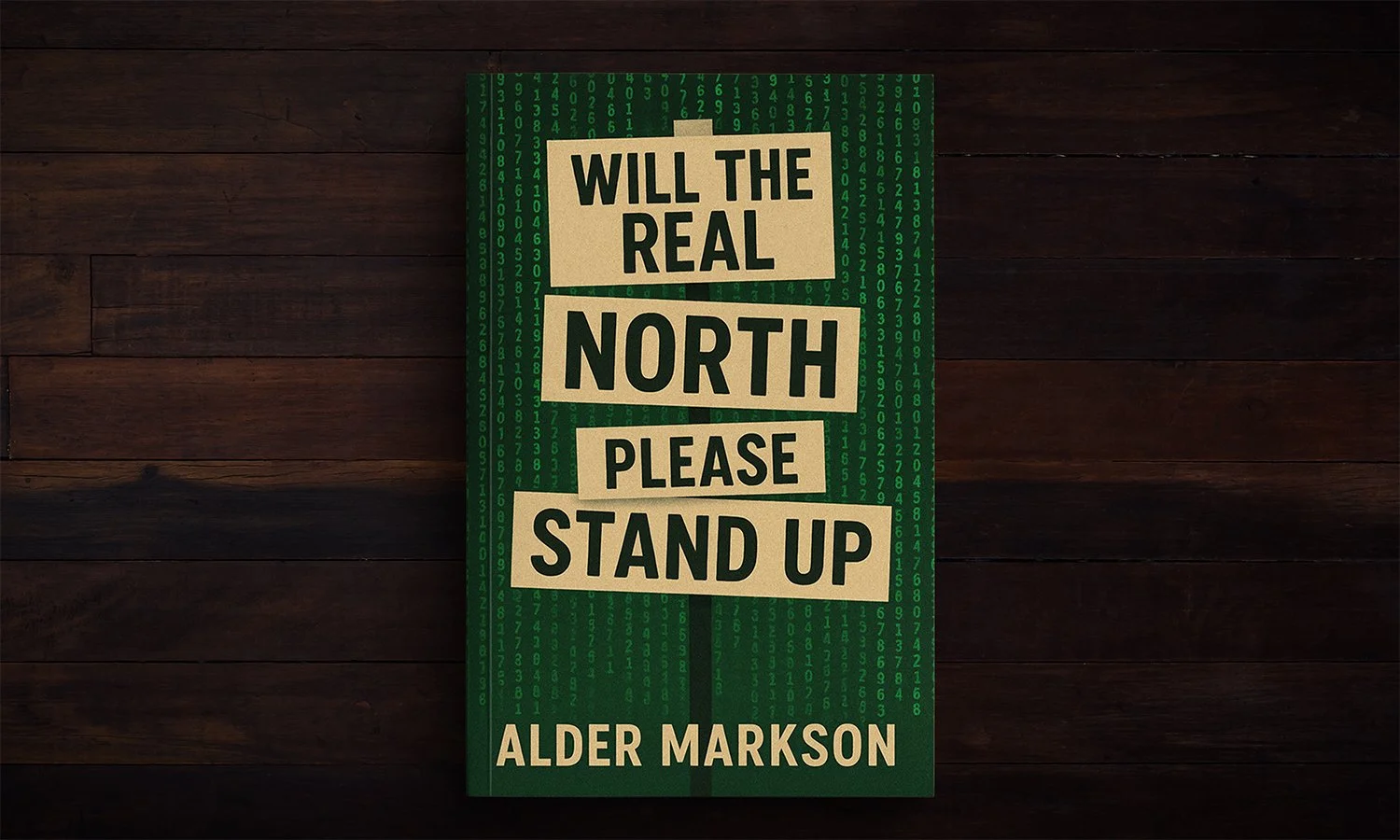
Will the Real North Please Stand Up
Revolution and division, two words charged with meaning, yet their real-world impact can vary dramatically. At their most literal, revolution refers to the forcible overthrow of an established government or social order, typically in response to injustice or corruption. Consider, for instance, the French Revolution of 1789, where widespread discontent among the lower classes led to dramatic upheaval and the birth of a new political system. More recently, the Arab Spring illustrated how populations can rise against regimes they deem unfair, seeking change not for grand ideological reasons but simply because they have had enough of poor conditions or lack of opportunity.
However, the word ‘revolution’ also has a physical meaning: the movement of an object in a circular or elliptical path around a centre. This cyclical nature of revolution mirrors the repetitive patterns often seen in societal change. Time and again, groups initiate bold reforms only to find themselves facing similar challenges as their predecessors. For example, the Russian Revolution promised sweeping social transformation, but over the decades, the country encountered cycles of oppression and reform, demonstrating how change can sometimes bring us back to familiar starting points. The enthusiasm for change may persuade many to support a revolution, but without understanding its underlying drivers, the outcome may be less substantial than anticipated.
Historically, dramatic change often depended on who wielded the greatest force, whether through armies, political power, or sheer bravado. Division in society was exploited by revolutionaries, who sought out weaknesses to foment unrest. Consider the Industrial Revolution: divisions between working and owning classes drove conflict and eventually led to the creation of trade unions and workers’ rights. Today, however, revolutions may not always take place on battlefields. Instead, change is increasingly achieved through subtler means, like mass communication and social media activism, think of how movements such as Black Lives Matter have used digital platforms to galvanise support and challenge established norms.
The metaphor of a black hole is apt when considering the impact of revolutions on society. Just as a black hole draws all matter into its centre, revolutions can absorb and transform entire cultures, pulling in people, ideas, and institutions. In the aftermath, what emerges is often unpredictable, a new system forged from the remnants of the old. Sometimes, those swept up in the vortex of change are powerless to resist, as happened to many during the Cultural Revolution in China, where millions were caught in the turmoil, and the very fabric of society was reshaped.
Division, the close companion of revolution, often arises out of differences between groups, sometimes based on ideology, but more frequently on social class. Social class acts as an invisible line, separating people into categories according to wealth, occupation, or education. The British class system, for example, has long divided society into working, middle, and upper classes, influencing everything from opportunities to cultural attitudes. Even today, debates about inequality and social mobility highlight how class continues to fuel tension and shape competitive interests between groups, sometimes leading to social change, other times to entrenched division.
Ultimately, these revolutions and divisions, whether driven by ideology, class, or circumstance, can often be traced back to the basic principles of social organisation. Social class, in particular, acts as a kind of taxonomic division, a simple line drawn across society, much like a phylum in zoology. The ‘genus of the north’ may well stand up and announce its transformation, reflecting the way groups seek recognition or change within a broader system. By using concrete examples and extended metaphors, it becomes clearer how these powerful forces shape the world we live in, reminding us that both revolution and division are not just abstract concepts, but living dynamics that continue to influence our lives.
*****
Let’s get ready to rumble
This new situation demanded Tina’s attention, and she knew she would have to think long and hard about it. Deep reflection was not a state she relished, but as Senior Executive Officer Rawson, a woman of rank and some substance, she often found it strangely difficult to fit into the world around her. The circumstances that had landed her, somewhat begrudgingly, in this unmarked Volvo needed more scrutiny. For once, she was not complaining about her luck. It had shone on her in a favourable light, thanks to Mike Crowther, her boss, who had rescued her from doing something very stupid. She wondered if she truly deserved this second chance, or if fate was simply toying with her once again.
As she stared absently at the modern carbuncle of an office block across the car park, Tina admitted to herself that she had avoided disaster only by chance. Mike had tidied up an error that could have been catastrophic to her career, and possibly her liberty. Life’s little quirks and foibles, she supposed, had spared her this time.
The deaths, no, the assassinations, as that was what they were, of Jack Kennelly and Ilya Fedorov stunned the waiting media. It was a spectacle no one had truly expected, certainly not the victims themselves. They had arrived with all the trappings of safety: flanked by Her Majesty’s finest, shielded by their lawyer, and trailed by a loyal journalist. It had been an American style walk-in with the TV crews and press cameras trained on the pair, as if their very presence could ward off danger. But in the end, nothing had protected them. An assassin, calm and unhurried, strode into the chaos and dispatched both men with chilling efficiency. Leaving two very probably now disgruntled corpses with the contents of their heads sprayed across the wet pavement.. Their blood mingled with rain on the pavement, their final thoughts lost amid the indifferent glare of flashbulbs accompanied by the screams and panic of those who had turned up to witness the circus.
This is where her luck had turned as Tina had been about to do exactly the same thing to the two men, her anger had been stoked to such a level in the previous few days she was prepared to risk everything. If she hadn’t had a Glock that she had picked up and hidden after her partner, Ray Pickard, had dropped it when he was injured in a bomb blast on the M1, then it might have been different. As using her own would have caused far too much paperwork.
Ironically the bombing was one of the many crimes that the pair of low-lives were accused of and had allegedly been going to supply answers for the very high-power investigation. The gunman, who the investigators knew had been methodically removing many of the witnesses and key players in the tragedy of the M1, had prevented Tina by seconds from literally blowing her career and freedom away.
Mike, who was allegedly a G2 in the National Crime Agency, although there was still some doubt about this provenance, but it technically made him her boss, had stepped in and taken the gun from Tina. He had told her he would tidy that all away and Tina had been left with no personal gratification and a whole bucket load of anger at the men that had set this whole thing in motion leading to the death of two innocent children, along with many others. Despite them now oozing brains out on slowly on the wet concrete in front of her the anger remained.
Luckily the one who had pulled the trigger had been followed, coincidentally by Tina’s now new partner, and he had been arrested thanks to the quick thinking of said. So, the anger had been tamped down a little knowing that the one who was responsible for all of the carnage following the bombing had been placed into custody. And was likely to remain so, for a very, very long time.
There had also been the odour of a spook hanging around, one from MI5 no less, his involvement in any of these matters had yet to be proven, or unproven. Peter Driver, however, was a person of interest to Tina, who had been trying to find the leak in the investigation and had narrowed it down to him. Which was odd as he seemed to have no discernible motive, and yet appeared to have very sticky, jam smeared fingers.
In the two weeks since everything had unfolded, there had been the inevitable tribute and sacrifice to the gods of paperwork. Tina also found herself with more downtime than she was used to or needed. Then Mike had called her in and set the wheels in motion, leading to her current situation: sitting here with Alice Riggs as her new partner. Tina wasn’t entirely sure how she felt about that. Alice, while not a total unknown, was, at least in Tina’s considered opinion, only a little bit shy of being a barmpot. The thought made her smirk. Trust Mike to pair her with someone who might just tip her already precarious sanity over the edge. Still, Tina supposed, things could always be worse, she could have been left alone with her thoughts and a mountain of forms, which was a fate she wouldn’t wish on her worst enemy.